



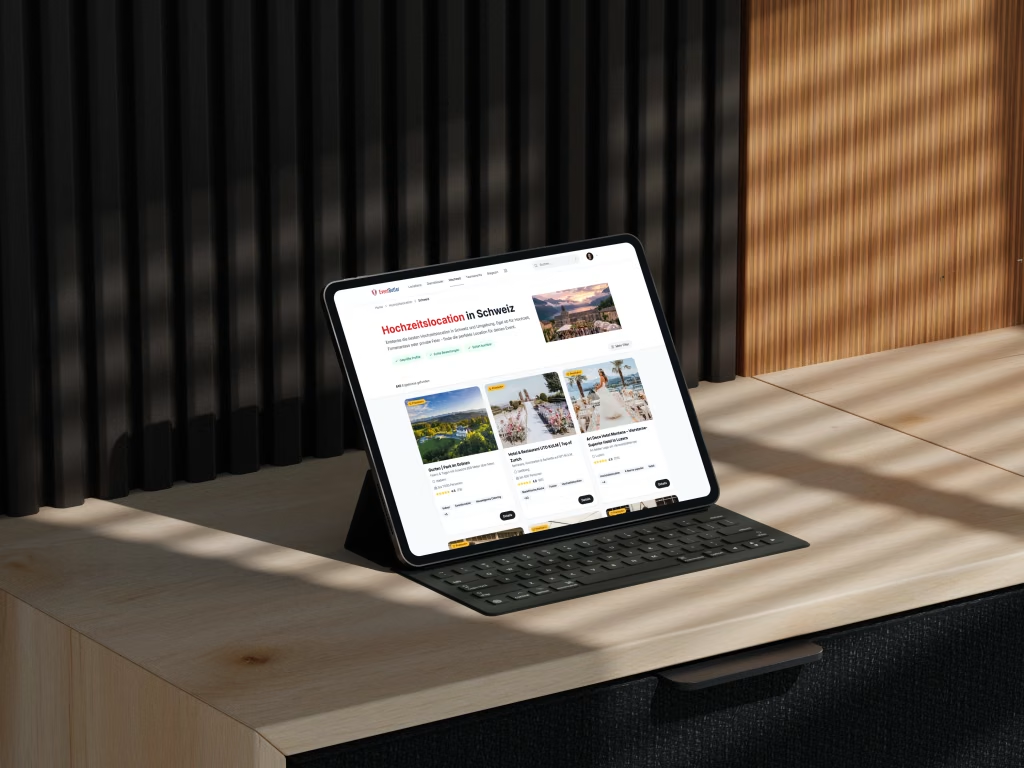


The problem: one portal, 17 target audiences
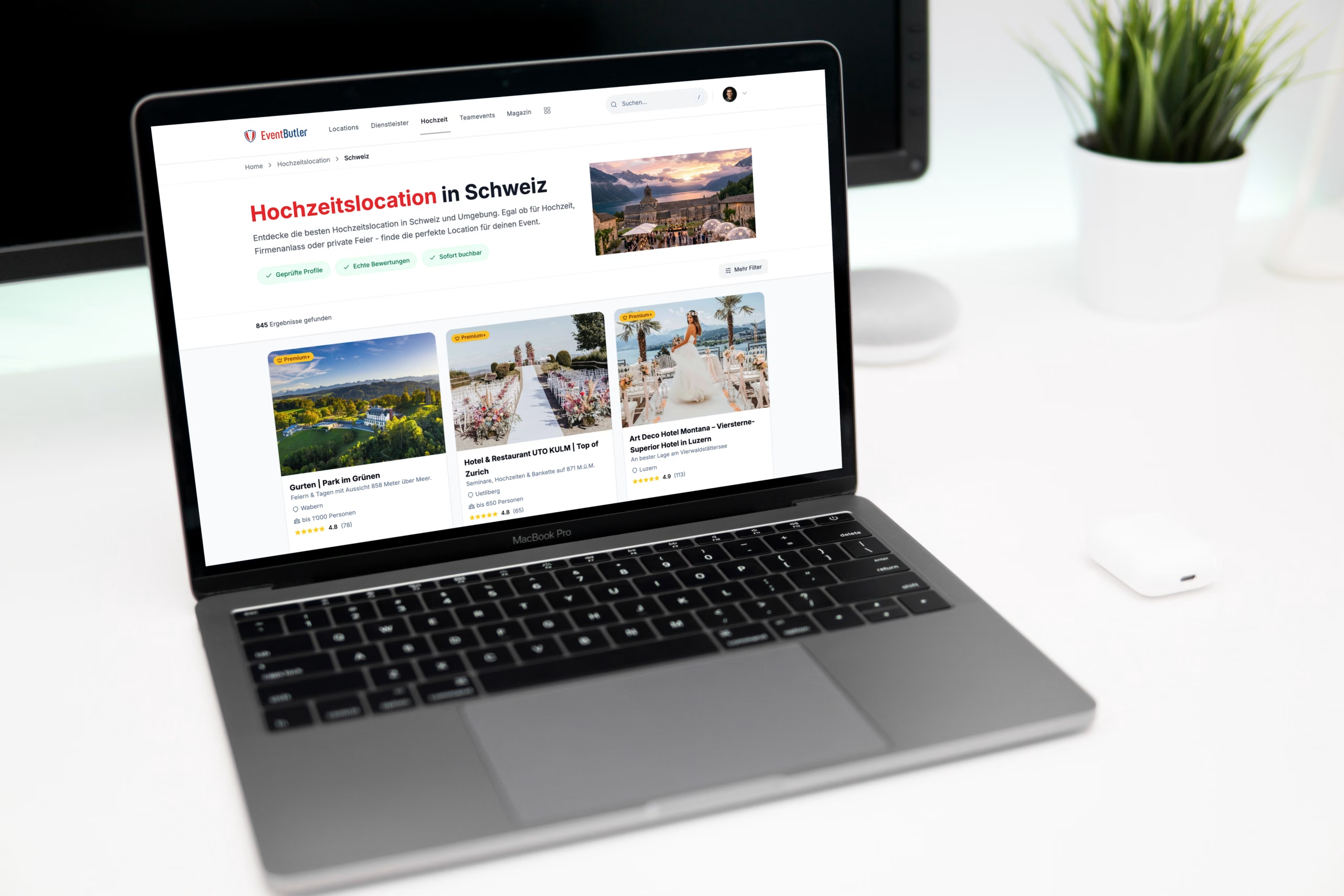
EventButler is aimed at event planners in Switzerland, Germany, Austria, Italy and Australia – in Switzerland alone, in four languages. A venue in Zurich should appear in French for a planner from Lausanne and in German for a planner from Munich – but with prices in euros and directions for travellers from Germany.
Without clean linking, the opposite happens: Google shows the planner from Lausanne the German page, or downgrades the language versions as duplicates.
The structure: two domains, one data set
We decided on two domains: .ch for Switzerland, .com for all other markets. Both access the same data set.
| URL | hreflang | Target audience |
|---|---|---|
| eventbutler.ch | de-CH |
Switzerland, German |
| eventbutler.ch/fr | fr-CH |
Switzerland, French |
| eventbutler.ch/it | it-CH |
Switzerland, Italian |
| eventbutler.ch/en | en-CH |
Switzerland, English |
| eventbutler.com/de | de-DE |
Germany |
| eventbutler.com/at | de-AT |
Austria |
| eventbutler.com/it | it-IT |
Italy |
| eventbutler.com/au | en-AU |
Australia |
The implementation in code
Every page outputs the complete list of all variants in its head. Important: the list is identical on all variants, and each variant also refers to itself.
<link rel="alternate" hreflang="de-CH" href="https://eventbutler.ch/location/zuerich-kunsthaus" />
<link rel="alternate" hreflang="fr-CH" href="https://eventbutler.ch/fr/location/zuerich-kunsthaus" />
<link rel="alternate" hreflang="de-DE" href="https://eventbutler.com/de/location/zuerich-kunsthaus" />
<!-- … 14 more … -->
<link rel="alternate" hreflang="x-default" href="https://eventbutler.com/location/zuerich-kunsthaus" />
In Next.js, we generate this list centrally from the market configuration so that no page forgets a variant.
Three mistakes we avoided
- Missing return links. If A refers to B but B does not refer back to A, Google ignores both annotations.
- Automatic redirects based on IP address. They lock Googlebot, which mostly crawls from the USA, out of all other markets.
- Canonical pointing to the main language. This declares all other languages to be duplicates – the opposite of what you want.
“Multilingualism is not a translation project. It is a question of architecture.”
Sebastian Utz
Why this also matters for AI answers
AI systems such as ChatGPT or Perplexity cite sources that they can clearly assign to a language and a location. Clean hreflang annotations and structured data for each market make exactly that possible: the answer to “event venue in Lausanne” then refers to the French-language Swiss page – not the German one.
Frequently asked questions
Only if you serve several German-speaking markets separately – for example Switzerland and Germany with different prices or content. Otherwise, no.
The page that search engines show when no language–market combination fits. At EventButler, that is the English version on .com – for the home page, the English home page.
No. Google recognises pure duplicate translations. Each combination needs its own titles, descriptions and – where it makes sense – its own content.
In our experience, a few weeks. Search Console shows errors in the hreflang linking long before rankings move.