







What GEO means
GEO stands for “generative engine optimisation”. It covers all measures that ensure AI assistants know a company, describe it correctly and mention it in their answers. These assistants include ChatGPT, Claude, Perplexity, Microsoft Copilot and Gemini – and the AI summaries in Google Search, the “AI Overviews”.
The reason is simple. Anyone who used to type “accountant Winterthur” into a search engine now increasingly asks an assistant: “Which accountant in Winterthur suits a craft business with ten employees?” The answer is not a list of ten links. It is a short text with two or three names. Whoever is missing there is not in the running at that moment.
How AI assistants arrive at their answers
An AI assistant has two sources of knowledge:
- Training knowledge. The language model was trained on large amounts of text. This knowledge has a cut-off date and can hardly be influenced from outside.
- Web search. For current or specific questions, the assistant searches the web, fetches a few pages and summarises them. It often breaks the question down into several search queries. It usually cites the pages it used as sources.
GEO starts mainly with web search. That is where it is decided whether your page is found, whether the assistant is allowed to fetch it and whether it can take a clear statement from it.
To do so, the assistants draw on search indexes, the directories of the search engines. For its AI features, Google states: a page must be indexed and eligible to appear in normal search with a snippet. There are no further technical requirements (Google Search Central). Without solid search engine optimisation (SEO), the foundation is missing.
How SEO and GEO differ
GEO does not replace SEO, it builds on it. But the goals and the measurement are different.
| SEO | GEO | |
|---|---|---|
| Goal | A good position in the results list | A mention or source citation in the answer |
| Result | List of links | Ready-written answer with a few sources |
| Query | A few keywords | Whole questions with context |
| What counts | Relevance of the page, technology, links | In addition: clear, evidenced statements and mentions on other websites |
| Measurement | Rankings, clicks, enquiries | Mentions for test questions, visits from AI assistants |
| Stability | Results change slowly | Answers vary from query to query |
Much of it overlaps: fast pages, a clean structure, content that really answers a question. What is new is that your own website is no longer all that counts. An assistant builds its answer from several sources – and these include what others write about you.
What works, as things stand
The research is young. Almost all analyses show correlations, not causes. Five points are nevertheless well founded.
- Access for AI crawlers. Crawlers are programs that fetch websites automatically. The providers distinguish between crawlers for training and crawlers for search. At OpenAI, one is called GPTBot, the other OAI-SearchBot. According to OpenAI, anyone who blocks the search crawler will not appear in ChatGPT’s search answers. Anthropic makes the same distinction for Claude. This is controlled in the
robots.txt, a text file with rules for crawlers. Hosting and security services also control access. With the widely used service Cloudflare, for example, search crawlers have been allowed by default since September 2026, while crawlers for training and AI agents are partly blocked (Cloudflare, September 2026). If you use such settings, check that the search crawlers get through. - Clear facts and unambiguous details. Who you are, what you offer, where and for whom – as text, not only in an image or PDF. Specialists speak of entities: clearly identifiable things such as a company, a place or a service. Name, address and services should read the same everywhere. An analysis of 54 studies and tests concludes: specific, verifiable facts and clear source references are closely linked to mentions in AI answers (Zyppy, May 2026).
- Structured data. This is information in the source code following the schema.org standard. It helps machines tell provider, place and service apart, and it must match the visible text. Soberly considered, it is a clean foundation, not a lever of its own: Google requires no special markup for its AI features.
- Mentions on other websites. AI systems rely more readily on brands they know and trust. The number of backlinks, the links from other websites, was by contrast often only weakly linked to mentions in the studies analysed (Zyppy, May 2026). Here too: this is a correlation, not proof of a cause. In practice, this means industry directories, associations, trade media and review portals all matter.
- Freshness. In an analysis of around 47,000 citations in ChatGPT, Gemini and Perplexity, three quarters of the cited pages had been updated within the last year (Seer Interactive, July 2026). Only 42 per cent, however, had first been published within the last year – revised older pages count just as much. Freshness helps, but it does not replace substance.
What to do on the website
These points lead to four tasks on your own website. Not all of them are backed by studies – where that is the case, it says so.
- Answer block. A short, direct answer at the top of the page: two or three sentences that answer the question in the heading before the details follow. An assistant can take over such a statement without having to extract it from a long text. We know of no study that measures exactly this. But the answer block follows from the principle of clear facts, and it also helps the people who read the page. In the content management system, it can be set up as a content element of its own, so that it is structured the same way on every page.
- One page per topic. If the same content can be reached at several addresses, it is unclear which page should count. In case of doubt, an outdated version gets cited. Microsoft states for the AI answers in Bing: an outdated fact leads to a misleading answer (Microsoft Bing, May 2026). Redirects, unambiguous page titles and canonical tags help here – the note in the source code saying which address is the authoritative one.
- Content in the HTML, delivered quickly. In a test in October 2026, ChatGPT, Claude and Perplexity could not read content that is only loaded via JavaScript in the browser. Gemini read all three test pages, Copilot two of them (Glenn Gabe, October 2026). Texts, prices and contact details therefore belong in the HTML delivered by the server. A short loading time makes sense anyway for visitors and for Google. That it also influences mentions in AI answers is plausible, but not yet proven.
- Don’t forget Bing. Microsoft Copilot fetches information from the web via the Bing search engine (Microsoft). For web search, ChatGPT uses third-party search providers according to OpenAI; which ones is not stated. In Bing Webmaster Tools, a website can be registered free of charge and the sitemap submitted. Since February 2026, a report there shows how often and with which pages a website is cited in Copilot and in Bing’s AI summaries (Bing Webmaster Blog, February 2026).
What has little evidence
A lot is promised around GEO. Some widespread recommendations have not stood up to scrutiny so far.
| Measure | State of the evidence |
|---|---|
llms.txt |
Hardly fetched, no link with citations measured |
| Special “AI markup” or separate page versions for AI | Not needed for the AI features of search, according to Google |
| Changing the date without revising the content | No evidence of any benefit |
| Guaranteed mentions (“number 1 in ChatGPT”) | Not serious – answers vary and cannot be controlled |
The llms.txt is a text file intended to list a website’s most important pages for AI systems. Ahrefs analysed around 137,000 websites: 97 per cent of the existing files were not fetched a single time in May 2026 (Ahrefs, June 2026). Across almost 300,000 domains, SE Ranking found no link between the file and citations in AI answers (SE Ranking, October 2026). Our conclusion: the file does no harm and is quickly created. It is not a lever.
How visibility can be measured
There is no ranking for AI answers. The same question can produce different names tomorrow, and every assistant answers differently. Measuring therefore means observing:
- Define a fixed set of questions that your customers actually ask.
- Ask the questions in several assistants, document the answers and repeat this regularly.
- Record whether you are mentioned, whether the description is correct, which competitors appear and which sources the assistant cites.
- Evaluate the visits coming from AI assistants in your web analytics.
- Look at the “AI Performance” report in Bing Webmaster Tools: it counts the citations in Copilot.
A single answer says little. What is meaningful is the trend over several months.
How we support you
UTZ MEDIEN offers SEO and GEO from one source. Three building blocks work together:
- GEO audit. Together with you, we define 20 to 30 questions your customers would ask. We ask them in several AI systems, document the answers and compare them with your competitors. We also check the website, structured data and external sources. You receive a written report with measures sorted by impact – usually after two to three weeks.
- Grounding pages. This is what we call fact pages about companies and services: one page per topic, clearly worded, with evidence and structured data. They are integrated into your website, linked and indexed. We review and update them quarterly. One example is our own fact overview.
- SEO as the foundation. Technical SEO, content based on search intent, multilingual websites, and the Google Business Profile and local pages.
In implementation, we divide the work. We take care of the technology: templates, structured data and delivery. The content stays with your team, because you know the facts best. For this, the team receives instructions and a list of pages sorted by impact. Before we start, we record the current state. After implementation, a before-and-after report shows what has changed.
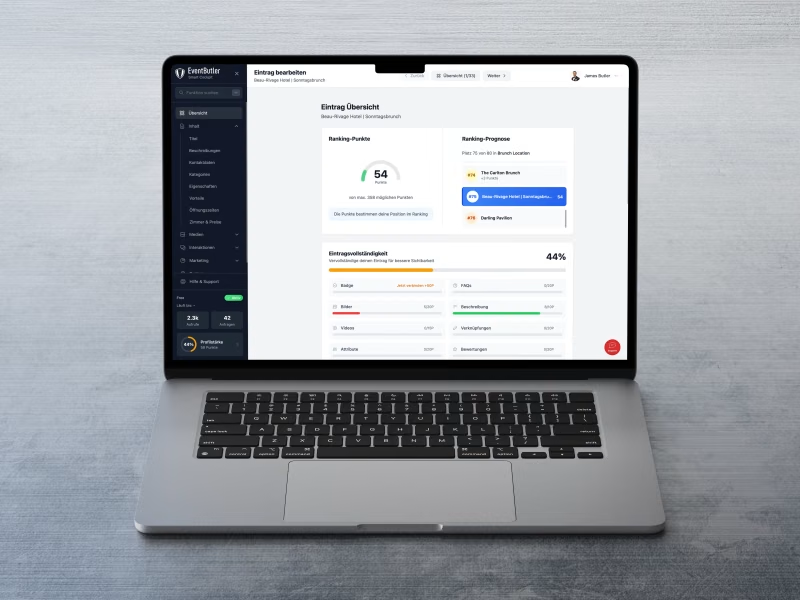
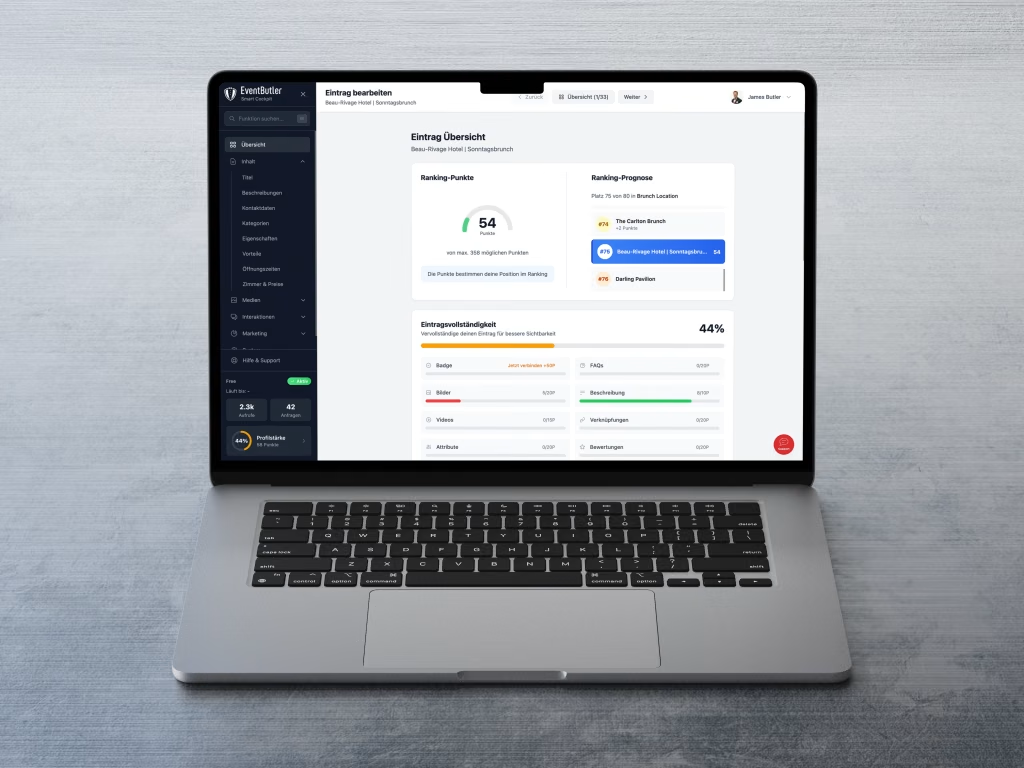
At EventButler, our own online portal, we put this into practice ourselves: with structured data for each entry type across 17 language–market combinations.
Our principle applies here too: we guarantee no rankings and no mentions. We measure visibility, clicks and enquiries – monthly.
In which order to proceed
It starts with a stocktake you can do yourself: ask three assistants five questions each that your customers would ask. Note who is mentioned and whether the details about you are correct. After that, we recommend three steps in this order:
- Foundation. Check access for the search crawlers, clean up duplicate content and page titles, standardise name, address and services and store them as structured data, register the website with Bing, introduce answer blocks on the most important pages.
- Structure and delivery. Keep the sitemap up to date, deliver content in the HTML, improve loading time, give articles a date, author and structured data.
- Review. Ask the same questions again after a few weeks, compare with the starting point and then decide which content is next.
The foundation comes first because it removes obstacles: not even the best text can make up for what cannot be fetched or is not unambiguous.
“An AI assistant only recommends those it understands. Our job is to make you understandable.”
Sebastian Utz
Frequently asked questions
No, GEO complements it. AI assistants draw on search indexes. A page that is not indexed by Google will not appear in Google’s AI Overviews either.
Not necessarily. Analyses from 2026 show that AI systems hardly fetch the file. It does no harm, but pages with clear facts that can be fetched matter more.
That varies. AI systems update their knowledge at different speeds – from a few days to several months.
No. The answers vary from query to query and cannot be controlled. The serious approach is to create the conditions and measure visibility regularly.